Red Sindhi Cow Milk Per Day: Yield, Fat %, Price & Complete Dairy Guide (2026)
By Shubham Jain · · Indian Cow Breeds
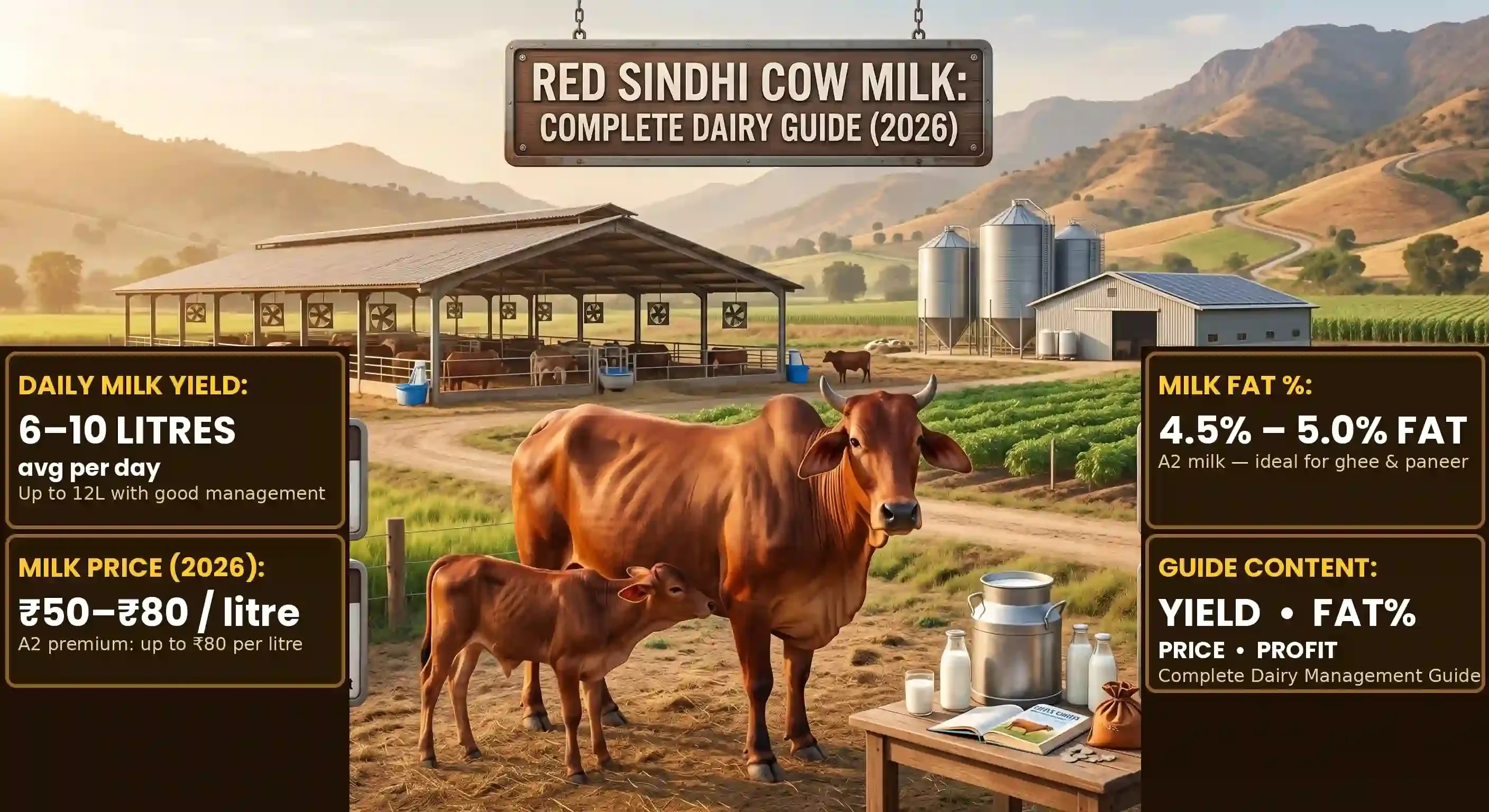
If you are a dairy farmer in India evaluating indigenous breeds, the Red Sindhi cow deserves serious attention. This guide covers everything you need to know — from daily milk yield and fat percentage to price, feeding, profitability, and how it compares to Sahiwal and Gir cattle. All figures are drawn from ICAR breed studies, field observations, and established Indian dairy literature.
What Is the Red Sindhi Cow?
The Red Sindhi is a purebred Indian milch cattle breed originating from the Sindh region of the Indian subcontinent (present-day Pakistan). Recognised officially by the National Bureau of Animal Genetic Resources (NBAGR), it is classified as a Bos indicus zebu breed known for its reddish coat, sturdy constitution, and reliable milk output even under harsh tropical conditions.
The breed is also referred to as Lal Sindhi or Red Karachi in older literature. Today, registered herds are maintained at livestock research stations across Rajasthan, Haryana, Punjab, Karnataka, Tamil Nadu, and Kerala — with crossbreeding programs extending its genetics into tropical countries such as Sri Lanka, Brazil, and parts of Southeast Asia.
According to ICAR's All India Coordinated Research Project on Cattle, Red Sindhi ranks among t+he top five indigenous breeds for tropical dairy suitability, specifically due to its tick resistance and heat stress adaptability.
Red Sindhi Cow Milk Per Day — Realistic Figures
Average Daily Milk Yield
Under typical smallholder farming conditions in India, a Red Sindhi cow produces 6 to 10 litres of milk per day. Well-managed animals with superior genetics, balanced nutrition, and scientific herd management can push this to 10–12 litres per day during peak lactation.
It is worth being direct about one thing: yield figures quoted in breed promotional material are often best-case scenarios from research stations. On an average Indian farm, expect 6–8 litres per day reliably, with better-genetic animals consistently touching 9–10 litres.
Complete Milk Yield Data Table
| Yield Parameter | Figures |
| Average daily yield (normal farm) | 6–10 litres/day |
| Peak daily yield (high-genetics, managed) | 10–12 litres/day |
| Total lactation yield (average) | 1,500–1,800 kg |
| Total lactation yield (research stations) | Up to 2,100 kg |
| Lactation length | 270–305 days |
| Dry period | 60–90 days |
| Calving interval | 15–18 months |
Source: ICAR Journal of Livestock Biodiversity; NBAGR Breed Descriptors for Red Sindhi Cattle.
What Affects Daily Milk Yield?
Several factors directly determine how much milk your cow gives per day:
- Genetics and Breed Purity — A cow from a verified breeding line (ICAR-registered or government livestock farm stock) will consistently outperform an unregistered animal. Always request parentage records when buying.
- Stage of Lactation — Yield peaks around weeks 6–8 after calving and gradually declines. A cow in early lactation will produce more than the same cow in month eight.
- Feed Quality and Quantity — Protein and energy deficiency are the single biggest suppressors of milk yield in Indian farming. A cow producing 8 litres per day needs approximately 2–2.5 kg of quality concentrate feed daily in addition to green and dry fodder.
- Water Intake — Milk is roughly 87% water. Cows that do not have free access to clean water throughout the day will produce less milk — a simple but frequently overlooked factor.
- Milking Frequency and Technique — Twice-daily milking at consistent intervals (roughly 12 hours apart) maintains better hormonal signalling and higher output than once-daily milking.
- Heat Stress Management — Even though Red Sindhi is heat-tolerant, prolonged exposure to temperatures above 40°C without shade or ventilation reduces feed intake and milk output. Providing shade, fans, and cool drinking water during peak summer months protects yield.
Also Read: Vechur cow Milk Per Day
Red Sindhi Milk Fat Percentage and Nutritional Quality
Fat Content
Red Sindhi milk carries a fat percentage of 4.5% to 5% on average — meaningfully higher than most crossbred cows (which typically range from 3.2% to 3.8%) and comparable to Sahiwal milk.
This higher fat content makes Red Sindhi milk particularly valuable for:
- Desi ghee production — where fat content directly determines ghee yield per litre of milk.
- Paneer and khoya — richer milk produces better texture and higher yield per kg.
- Premium A2 milk sales — where customers pay a significant price premium for indigenous breed milk.
- Curd and butter — the cream layer is thicker and more stable.
SNF and Protein
The Solids Not Fat (SNF) content typically ranges from 8.5% to 9%, and protein content averages around 3.5%, making it nutritionally superior to standard toned or double-toned milk sold commercially.
Is Red Sindhi Milk A2 Type?
Red Sindhi, as a Bos indicus breed, predominantly carries the A2 beta-casein gene — the milk protein variant associated with easier digestion and absence of the BCM-7 peptide that is linked to digestive discomfort in some individuals consuming A1 milk.
However, individual animals can vary. If you intend to market your milk specifically as "certified A2," invest in genetic testing through NDDB or a NABL-accredited laboratory — this typically costs ₹1,500–₹3,000 per animal and adds significant commercial value to your milk brand.
Physical Characteristics and Breed Identification
Knowing how to identify a genuine Red Sindhi cow protects you from purchasing a crossbred animal at a purebred price.
| Characteristic | Description |
| Body Colour | Deep red to reddish-brown; uniform across the body |
| Body Size | Medium-framed; cows weigh 280–350 kg |
| Horns | Short to medium, thick at base, curving outward and upward |
| Hump | Moderately developed in cows; more prominent in bulls |
| Dewlap | Well-developed, pendulous |
| Udder | Capacious, well-attached, with prominent milk veins |
| Ears | Medium-sized, drooping |
| Temperament | Calm, docile, easy to handle |
| Skin | Loose, pigmented, resistant to ticks and insects |
The deep uniform reddish coat is the most reliable visual identifier. Animals with patchy colouring, white spots, or very light brown shades are likely crossbreds. Always check the udder development and milk vein prominence — well-developed milk veins running along the abdomen indicate good dairy genetics.
Red Sindhi Cow Price in India (2026)
Prices vary widely depending on milk yield, purity, pregnancy status, and source location. The following ranges reflect 2025–26 market conditions.
| Animal Category | Approximate Price Range |
| Young heifer (8–18 months) | ₹35,000 – ₹65,000 |
| Pregnant heifer (first calving) | ₹55,000 – ₹90,000 |
| Milking cow (average yield, 6–8 L/day) | ₹70,000 – ₹1,20,000 |
| High-yield milking cow (9–12 L/day) | ₹1,30,000 – ₹2,50,000 |
| Verified purebred, registered pedigree | ₹2,50,000 – ₹4,00,000+ |
Buyer Tips:
- Purchase from government livestock farms (such as ICAR research stations or state animal husbandry department farms) if breed purity is critical. These animals carry documented performance records.
- Privately sourced cows should come with at least two lactation yield records verified by the seller.
- Avoid buying cows described vaguely as "Red Sindhi cross" — get clarity on parentage.
- Have a veterinarian conduct a pre-purchase health check for BRD, mastitis, and reproductive history.
Also Read: Sahiwal cow milk per day
Feeding Guide for Maximum Milk Production
Nutrition is the lever that most directly influences how much milk your Red Sindhi cow gives per day. Many farmers underperform their herd by 20–30% simply due to inadequate feeding.
Daily Feed Requirements (for a 300 kg cow producing 8 litres/day)
| Feed Type | Recommended Daily Amount |
| Green fodder (Napier, Berseem, Maize) | 20–25 kg |
| Dry fodder (hay, wheat straw) | 4–5 kg |
| Concentrate feed (balanced) | 2–2.5 kg |
| Mineral mixture | 50–60 g |
| Common salt | 30–40 g |
| Clean drinking water | 40–60 litres |
Key Feeding Principles
- Feed for milk, not just maintenance. Many small farmers feed enough to keep the animal alive but not enough for full milk production. For every litre of milk beyond the first 3 litres, provide an additional 250–300 g of concentrate feed.
- Mineral supplementation is non-negotiable. Calcium, phosphorus, and zinc deficiencies are extremely common in Indian dairy farming and directly suppress milk yield, fertility, and immunity. A quality mineral mixture given daily costs very little and returns significant yield benefits.
- Avoid sudden feed changes. The rumen microbiome takes 2–3 weeks to adapt to a new feed. Abrupt changes cause acidosis and drop milk production sharply.
- Prioritise green fodder during lactation. Berseem, Lucerne, and Napier grass are high-energy, high-protein options that support peak yield. During dry months, silage made from maize or sorghum is the best substitute.
Red Sindhi vs Sahiwal vs Gir: Which Breed Is Right for You?
Farmers frequently compare these three leading indigenous dairy breeds. Here is an honest comparison.
| Parameter | Red Sindhi | Sahiwal | Gir |
| Average Milk/Day | 6–10 litres | 8–10 litres | 6–10 litres |
| Peak Yield | 10–12 litres | 10–12 litres | 10–15 litres |
| Lactation Yield (avg) | 1,500–1,800 kg | 1,700–2,100 kg | 1,600–2,500 kg |
| Milk Fat % | 4.5–5% | 4.5–5.5% | 4.5–5% |
| Heat Tolerance | Excellent | Excellent | Excellent |
| Tick/Disease Resistance | Very High | High | Very High |
| Temperament | Docile | Docile | Slightly aggressive |
| Body Size | Medium | Medium-Large | Large |
| Price Range | ₹70K–₹2.5L | ₹80K–₹3L | ₹1L–₹5L+ |
| Best Suited For | Hot-dry regions, small farms | Punjab, Haryana, UP | Gujarat, Maharashtra, large farms |
Summary:
- Choose Red Sindhi if you are in a hot and arid region, running a small-to-medium operation, and want a manageable, hardy animal with reliable yield.
- Choose Sahiwal if you are in a more moderate climate and want slightly higher average milk output.
- Choose Gir if you have access to high-quality animals (especially from Saurashtra), larger land, and are targeting the premium A2 milk market — the Gir's yield potential is the highest among the three when genetics are superior.
Also Read: Punganur Cow Milk Per Day
Is a Red Sindhi Cow Profitable in 2026?
This depends on your cost structure and milk selling price, so let's work through an honest example.
Sample Profitability Calculation (Monthly)
Assumptions: Cow producing 8 litres/day; milk price ₹50/litre (regular) or ₹80/litre (A2 premium); 25 milking days/month.
| Item | Regular Milk | A2 Premium Milk |
| Monthly milk income | ₹10,000 | ₹16,000 |
| Feed cost (green + dry + concentrate) | ₹3,500 | ₹3,500 |
| Mineral mixture + salt | ₹200 | ₹200 |
| Veterinary / miscellaneous | ₹500 | ₹500 |
| Net Monthly Profit | ₹5,800 | ₹11,800 |
Key takeaway: Selling regular milk at market rate provides modest returns. The profitability improves dramatically when you either sell directly to consumers as A2 milk (cutting out the middleman) or process milk into ghee, paneer, or curd — value-added products that can multiply returns by 2–3x.
Farmers running 5–10 Red Sindhi cows with direct-to-consumer or farm-gate sales are reporting net profits of ₹40,000–₹90,000 per month in 2025–26, particularly in peri-urban areas.
Lifespan and Reproductive Performance
A well-cared-for Red Sindhi cow lives 15 to 20 years and remains productively milking for 8–12 lactations. This longevity is a significant economic advantage over crossbred or exotic breeds, which are often culled after 4–6 lactations.
Key reproductive data:
- Age at first calving: 36–42 months (3–3.5 years)
- Gestation period: 280–285 days
- Calving interval: 15–18 months (target: under 16 months with good management)
- Conception rate: 70–80% with proper reproductive management
Reducing the calving interval from 18 months to 15 months through timely heat detection and artificial insemination adds one extra lactation every 5–6 years — a meaningful long-term yield and profit gain.
Common Health Issues and Prevention
Red Sindhi cattle are genuinely more disease-resistant than crossbred or exotic breeds, but prevention remains important.
| Disease / Condition | Prevention / Management |
| Foot and Mouth Disease (FMD) | Annual vaccination; mandatory under national programme |
| Haemorrhagic Septicaemia (HS) | Annual vaccination before monsoon |
| Brucellosis | Vaccination of heifers (S19 vaccine) at 4–8 months |
| Mastitis | Proper milking hygiene; teat dipping post-milking; dry cow therapy |
| Internal parasites | Deworming every 6 months |
| Tick-borne diseases | Regular tick inspection; acaricide treatment during high-risk seasons |
Establishing a relationship with a local veterinarian and following the state animal husbandry department's vaccination calendar is the single most cost-effective health investment you can make.
Final Verdict
The Red Sindhi remains one of India's most dependable indigenous dairy breeds for a clear set of reasons: reliable milk yield, high-fat quality milk, exceptional heat and disease tolerance, and a long productive lifespan. It is particularly well-suited for small and medium dairy farmers in hot, semi-arid regions who want a manageable, hardy animal without the input demands of crossbred or exotic breeds.
For farmers targeting the growing premium A2 milk or desi ghee market, Red Sindhi cows — especially from verified breeding lines — represent a strong long-term investment.
If you are comparing breeds before purchase, also read our detailed guides on Sahiwal Cow Milk Per Day and Gir Cow Milk Per Day to make the most informed decision for your farm and region.
Sources & Research:
This article has been compiled using breed data from the ICAR Journal of Livestock Biodiversity, NBAGR official breed descriptors, and field data from dairy farming sources across Rajasthan, Punjab, and Tamil Nadu. Prices and yield figures reflect 2025–26 conditions and may vary by location.
Frequently asked questions
How much milk does a Red Sindhi cow give per day?
Under normal Indian farming conditions, a Red Sindhi cow gives 6 to 10 litres of milk per day. High-genetic animals under scientific management can produce 10–12 litres during peak lactation.
What is the fat percentage in Red Sindhi cow milk?
The milk fat content ranges from 4.5% to 5% on average — significantly higher than most commercial crossbred cow milk.
Is Red Sindhi cow milk A2 type?
Yes, Red Sindhi is a Bos indicus breed and predominantly produces A2 beta-casein milk. Genetic testing through a certified lab is recommended if you intend to certify and sell milk specifically as A2.
What is the price of a Red Sindhi cow in India in 2026?
Prices range from approximately ₹70,000 for an average milking cow to ₹2.5 lakh or more for a high-yield, pedigree-verified animal. Government livestock farm purchases offer certified animals with documented yield records.
Which is better — Red Sindhi or Sahiwal?
Both are excellent indigenous dairy breeds. Sahiwal tends to produce slightly more milk on average and performs well in Punjab and Haryana. Red Sindhi is better suited to hotter, drier climates and is more resilient in harsher conditions. The right choice depends on your region and farm scale.
How long does a Red Sindhi cow live?
With proper nutrition, veterinary care, and management, Red Sindhi cattle live 15–20 years and sustain productive dairy careers for 8–12 lactations.
What should I feed a Red Sindhi cow for maximum milk yield?
A balanced daily diet should include 20–25 kg of green fodder, 4–5 kg of dry fodder, 2–2.5 kg of concentrate feed, 50 g of mineral mixture, and free access to clean drinking water (40–60 litres/day). Consistent feeding schedules and good-quality roughage have a direct impact on daily yield.
From desi cows to your kitchen
Shop A2 ghee →
Desi A2 Buffalo Ghee – Pure Bilona Buffalo Ghee 1kg Price
₹1,500.00₹3,000.0050% off