







Blog

Pure ghee has always been a symbol of health, tradition, and nourishment in Indian households. But as demand has grown, so has the problem of ghee adulteration. Many families today unknowingly consume products that look like ghee but contain cheap oils, hydrogenated fats, or artificial flavours. This not only reduces nutritional value but can also affect long-term health.
This article explains everything you need to know—what adulteration means, why it’s so common, and how you can protect yourself by identifying pure ghee at home.
What Is Ghee Adulteration?
Ghee adulteration refers to the mixing of pure ghee with cheaper, inferior, or unsafe substances. These can include vegetable oils, vanaspati, animal fats, starch, or even chemical additives that mimic the aroma of real ghee.
The motive is usually simple:
- Reduce production costs
- Increase profit margins
- Produce large quantities quickly
But the result is harmful—consumers lose both quality and safety.
Why Is Ghee Adulteration Increasing?
There are several reasons behind the rising cases of adulteration in the dairy industry:
1. High Cost of Pure Milk Fat
Producing real ghee requires large amounts of milk and a long processing time. Cheaper oils and fats reduce the cost drastically.
2. Rising Market Demand
As more people shift towards Ayurvedic and traditional diets, the demand for ghee is higher than ever. Unscrupulous manufacturers try to cash in.
3. Lack of Raw Milk Availability
Seasonal shortages and low-quality milk supply push some producers to use shortcuts.
4. Low Awareness Among Consumers
Most people judge ghee by colour or aroma, which can be easily faked. This lack of awareness encourages fraud.
Common Adulterants Found in Ghee
Some of the substances used in ghee adulteration are extremely harmful:
- Vanaspati / Hydrogenated fat – Increases bad cholesterol (LDL), harmful for heart health.
- Palm oil / Vegetable oils – Very cheap, lowers nutritional value, often used to bulk up quantity.
- Animal body fats (tallow) – Chemically modified to look like ghee.
- Artificial flavours & colouring agents – Used to mimic the aroma of pure desi ghee.
- Starch & chemical thickeners – Used to change consistency and melting behaviour.
Many of these adulterants show no immediate symptoms but can cause long-term health issues.
How Ghee Adulteration Affects Health
Consuming adulterated ghee regularly can lead to:
- Higher cholesterol levels
- Inflammation and digestive discomfort
- Weight gain due to unhealthy fats
- Reduced vitamin absorption
- Possible long-term metabolic issues
Pure ghee is known for its antioxidants, good fats (CLA), and digestive benefits. Adulterated alternatives remove all these advantages.
How to Detect Ghee Adulteration at Home
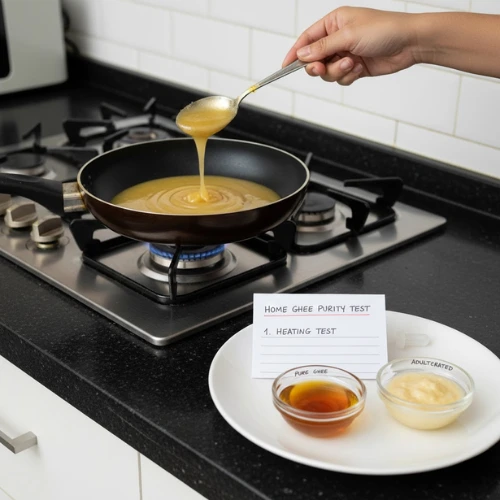
Simple checks can help you understand whether your ghee is pure or mixed:
1. The Melting Test
Take a small spoon of ghee and heat it gently.
- Pure ghee melts uniformly and becomes clear.
- Adulterated ghee may leave white residues or separate into layers.
2. The Aroma Test
Warm a small amount on your palm.
- Real ghee has a natural, pleasant, slightly nutty aroma.
- Fake versions smell oily or artificial.
3. The Iodine Test (Starch Check)
Add a few drops of iodine solution to melted ghee.
- If the colour turns blue, it indicates starch—an adulterant.
- Pure ghee will show no colour change.
4. Refrigeration Test
Place a small bowl of ghee in the fridge for 1 hour.
- Pure ghee solidifies evenly.
- Adulterated products may form distinct layers due to mixed oils.
5. Grain Test
After cooling, rub ghee between your fingers.
- Pure homemade-style ghee often has a grainy texture.
- Smooth, sticky texture may be a sign of added fats.
How to Choose Pure and Safe Ghee
Here are reliable ways to protect yourself from ghee adulteration:
- Check for FSSAI License & Batch Details
A genuine product always has proper regulatory markings.
- Read the Ingredient List
The label should mention only milk fat—nothing else.
- Avoid Too-Cheap Options
If the price is much lower than the market average, it’s a red flag.
- Prefer Small-Batch, Traditional Methods
Hand-churned, bilona, or farm-based ghee producers generally maintain purity.
- Check Brand Transparency
Look for companies that clearly share their source of milk, process, and quality tests.
Why Pure Ghee Matters
Pure ghee is more than a cooking ingredient—it is a part of Indian culture and Ayurvedic healing. It supports digestion, improves immunity, reduces inflammation, and provides essential fat-soluble vitamins. But when adulteration occurs, all these benefits are lost or reversed.
Raising awareness is the first step towards reducing ghee adulteration in the market. As more consumers become informed, dishonest practices automatically decline.
When Buying A2 Ghee or Cow Ghee, Keep These Quick Checks in Mind
1. Check the Source of Milk
A2 ghee should clearly mention the breed, such as Gir, Sahiwal, or Red Sindhi cows. Genuine brands share farm details or milk sourcing information.
2. Look for the Preparation Method
Traditional bilona or hand-churned methods usually ensure better purity. The label should mention the exact process used.
3. Ensure It Has Only One Ingredient
The ingredients list must show 100% milk fat. There should be no added oils, flavours, colours, or stabilizers.
4. Verify FSSAI License and Batch Number
A trustworthy brand will always provide proper FSSAI details, manufacturing date, batch number, and packaging information.
5. Check the Aroma and Texture
Pure A2 ghee has a natural, nutty aroma and may have a grainy texture. Artificial or overly strong fragrance can indicate adulteration.
6. Avoid Extremely Cheap Products
A2 milk is expensive, so genuine A2 ghee cannot be “too cheap.” Very low-priced products are often mixed with refined oils.
7. Prefer Smaller, Transparent Brands
Brands that show their farms, process videos, or lab testing reports are more reliable than anonymous mass-market sellers.
Final Thoughts
Ghee adulteration is a serious issue, but with the right knowledge, you can avoid unsafe products and choose only high-quality ghee for your family. A few simple home tests, careful label reading, and choosing reliable brands can make all the difference.
Educated consumers build a healthier market—and your awareness helps ensure that the ancient goodness of ghee stays pure for generations.
FAQs on Ghee Adulteration
1. What is ghee adulteration?
Ghee adulteration means mixing pure ghee with cheaper substances like vegetable oils, vanaspati, animal fat, or artificial flavours. This reduces the purity and nutrition of the ghee.
2. Why is ghee adulterated?
Because pure ghee is expensive to produce, some manufacturers add low-cost oils or fats to increase profit and quantity.
3. How can I check if ghee is adulterated at home?
You can use simple tests such as the melting test, refrigerator test, aroma test, or iodine test. Pure ghee melts evenly, smells natural, and shows no colour change with iodine.
4. Is adulterated ghee harmful?
Yes. Regular consumption of adulterated ghee may increase bad cholesterol, affect digestion, cause inflammation, and reduce the benefits of real ghee.
5. What are the common adulterants used in ghee?
The most common adulterants include vanaspati, hydrogenated fat, refined vegetable oils, palm oil, artificial flavours, and sometimes animal body fat.
6. Does pure ghee solidify in winter?
Yes. Pure ghee normally solidifies in cold weather and melts in warm temperatures. This is a natural behaviour and not a sign of adulteration.
7. Why does pure ghee have a grainy texture?
The grainy texture comes from the slow cooling process during preparation. It is a good sign that the ghee is made using traditional methods.
8. Can colour indicate ghee purity?
No. Colour alone cannot determine purity. Some adulterated products use artificial colours to mimic the golden shade of real ghee.
9. Is bilona ghee less likely to be adulterated?
Bilona or hand-churned ghee is usually made in small batches and is considered more trustworthy. However, always check labels and brand transparency.
10. How should I choose the right brand to avoid adulteration?
Look for FSSAI approval, clear ingredient lists, transparent sourcing, and brands that explain their preparation method. Avoid products that are unusually cheap.