








Blog
Calories in Ghee: Nutrition Facts, Health Benefits & How to Use Ghee Correctly

Calories in ghee are often misunderstood. One tablespoon of golden ghee contains roughly 120 calories, making it a calorie-dense yet nutrient-rich functional fat. While many think of ghee as simply “clarified butter,” it is actually a complex lipid profile rich in short-chain fatty acids and fat-soluble vitamins that support digestion, nutrient absorption, and overall wellness.
In this guide, we will break down the ghee nutrition facts, explain how many calories are in 1 tablespoon, compare ghee with butter and common cooking oils, and explore its health benefits, including why it is prized in both Ayurveda and modern low-carb or keto diets. By the end, you’ll know how to use ghee correctly to maximize its benefits without overconsuming calories.
How Many Calories in 1 Tablespoon of Ghee?
There are approximately 120 calories in 1 tablespoon (14g) of ghee. While this may seem high, nearly 100% of these calories come from healthy fats, including MCTs (Medium-Chain Triglycerides), which the body can use for immediate energy.
Calories in One Chapati with Ghee
A plain medium-sized chapati (about 30g) contains approximately 70–80 calories. When you add 1 teaspoon of ghee (5g) on top, it adds around 45 calories. So, 1 chapati with ghee contains approximately 115–125 calories.
Breakdown:
| Item | Quantity | Calories |
| 1 Plain Chapati | 1 Medium (~35g) | 75 kcal |
| Ghee | 1 Teaspoon (5g) | 45 kcal |
| Total (Standard) | 1 Chapati + 1 tsp Ghee | 120 kcal |
What Exactly Is Ghee? (The Science of Clarification)
Ghee is pure anhydrous milk fat obtained by slowly simmering butter and removing milk solids. This process eliminates:
- Water – improving shelf life
- Lactose & Casein – making it suitable for many with dairy sensitivities
The Bilona Difference
Traditionally, ghee is made using the Bilona method, where whole milk is cultured into curd, churned into butter (makkhan), and then gently heated. This slow process helps retain beneficial short-chain fatty acids like butyric acid, which are often reduced in industrial, cream-based ghee.
Calories & Nutrition Facts of Ghee:
Although 100% of ghee’s calories come from fat, fat quality matters more than fat quantity. Ghee contains short- and medium-chain fatty acids that are metabolized more efficiently and used as energy rather than stored as body fat.
Complete Nutritional Breakdown (Per 1 Tablespoon / 14g) of ghee
| Nutrient | Amount | % Daily Value |
| Calories | 120 kcal | 6% |
| Total Fat | 14 g | 18% |
| Saturated Fat | 9 g | 45% |
| Monounsaturated Fat | 4 g | — |
| Polyunsaturated Fat | 0.5 g | — |
| Omega-3 Fatty Acids | ~45 mg | — |
| Vitamin A | 108 mcg | ~12% |
| Vitamin D | 0.1 mcg | 1% |
| Vitamin E | 0.4 mg | 2% |
| Vitamin K | 1.1 mcg | 1% |
| CLA (Conjugated Linoleic Acid) | ~0.2 g | — |
| Butyric Acid | ~0.5 g | — |
Why Ghee Outperforms Other Cooking Fats
Smoke Point of Ghee: Why It’s Safer for High-Heat Cooking
Many refined oils break down at high heat, producing harmful free radicals.
- Butter smoke point: ~175°C
- Ghee smoke point: ~250°C
This stability makes ghee one of the safest fats for sautéing and frying.
Enhanced Nutrient Bioavailability
Vitamins A, D, E, and K are fat-soluble. Consuming vegetables, spices (like turmeric), or greens with ghee improves nutrient absorption — a concept deeply rooted in Ayurveda and supported by modern nutrition science.
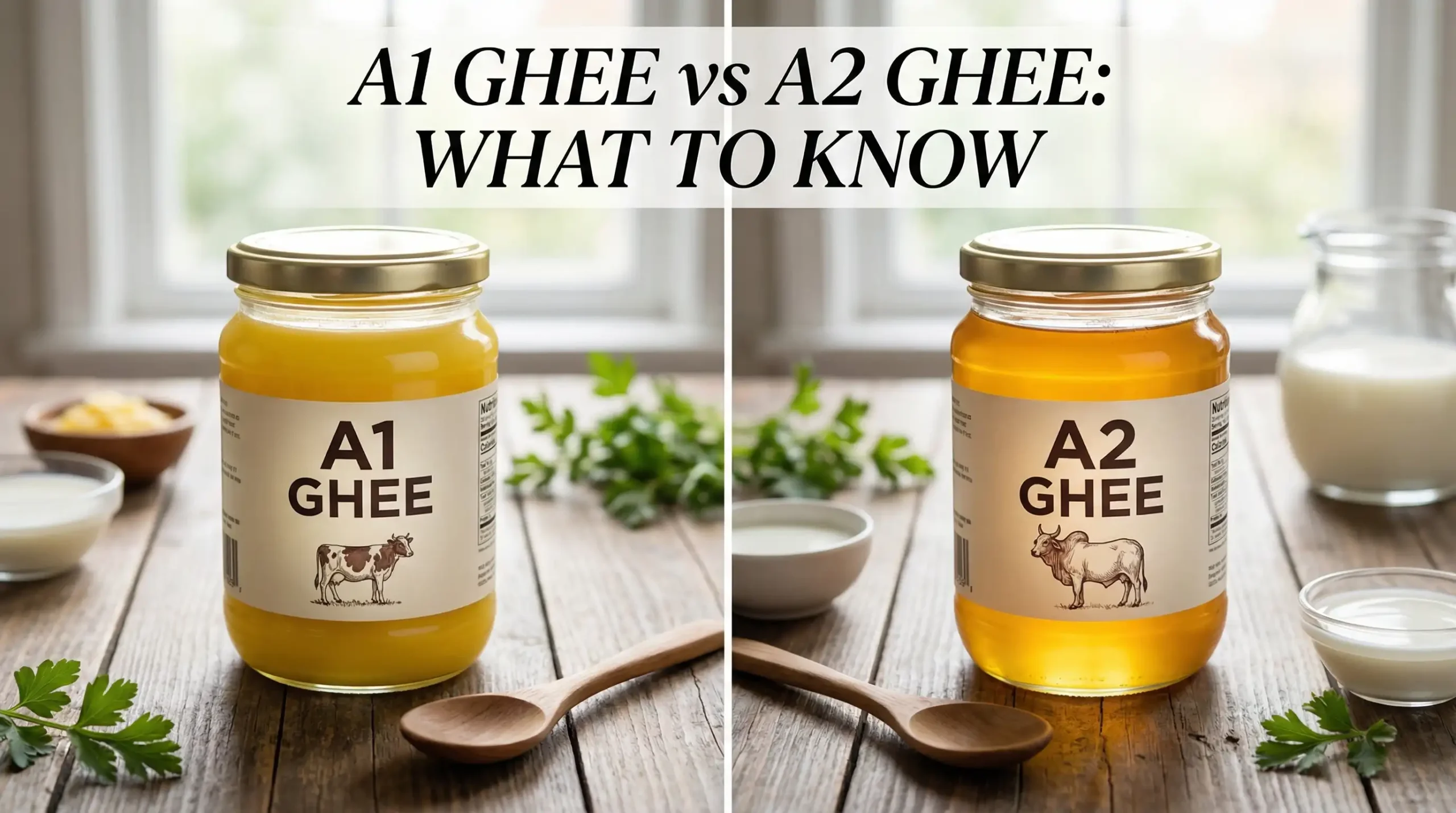
Cow Ghee vs Buffalo Ghee
| Feature | Cow Ghee (A2) | Buffalo Ghee |
| Color | Yellowish (beta-carotene) | White |
| Digestibility | Easier | Heavier |
| Fat Content | Moderate | High |
| Best For | Daily consumption | Weight gain / high activity |
A2 Ghee vs Other Cooking Fats (Per 1 Tablespoon / 14g)
| Nutrient | A2 Ghee | Regular Butter | Coconut Oil | Olive Oil |
| Calories | 120 kcal | 102 kcal | 117 kcal | 119 kcal |
| Total Fat | 14 g | 11.5 g | 13.5 g | 13.5 g |
| Saturated Fat | 9 g | 7.3 g | 11.7 g | 1.9 g |
| Monounsaturated Fat | 4 g | 3.3 g | 0.8 g | 9.9 g |
| Polyunsaturated Fat | 0.5 g | 0.4 g | 0.2 g | 1.4 g |
| Vitamin A | 108 mcg | 97 mcg | 0 mcg | 0 mcg |
| Smoke Point | 485°F (252°C) | 350°F (177°C) | 350°F (177°C) | 375°F (190°C) |
| Lactose | Free | Present | Free | Free |
| Best For | High-heat Indian cooking | Baking, spreading | High-heat, vegan cooking | Salads, low-heat cooking |
Note: Nutritional values are approximate and may vary based on source, processing method, and brand.
Benefits of Ghee for Weight Loss & Overall Health
- Gut Health Support: Ghee is a natural source of butyrate, which fuels intestinal cells and supports a healthy gut lining.
- Weight Management (When Used Correctly): Ghee contains Conjugated Linoleic Acid (CLA), which may support fat metabolism when combined with an active lifestyle.
- Heart Health Perspective: Moderate ghee consumption, when used instead of trans fats or refined oils, has been associated with improved HDL (good cholesterol) without significantly increasing LDL.
Calories in Ghee-Based Foods
| Food Item | Typical Ghee Used | Approx Calories |
| 1 Ghee Roti | ½ tsp | ~130 kcal |
| 1 Ghee Paratha | 1–2 tsp | ~280 kcal |
| 1 Bowl Dal Tadka | 1 tsp | ~180 kcal |
| 1 Besan Ladoo | 1.5 tsp | ~210 kcal |
How to Use Ghee Correctly (Dos & Don’ts)
✅ Do:
- Use ghee as a finishing fat on hot food
- Add small amounts to coffee or warm water (popular in keto diets)
❌ Don’t:
- Reuse ghee multiple times for deep frying
- Exceed 1–2 teaspoons daily if you lead a sedentary lifestyle
How to Check Ghee Purity at Home (Quick Tests)
Before worrying about calories, ensure your ghee is pure. Adulterated ghee can contain vanaspati or starch, which negatively impacts heart health.
- The Heat Test: Melt a teaspoon of ghee in a pan. If it melts immediately and turns dark brownish, it is pure. If it takes time to melt and turns light yellow, it may be adulterated.
- The Palm Test: Put a bit of ghee on your palm. Pure ghee has a melting point slightly below body temperature. If it melts on your skin without rubbing, it is pure.
- The Iodine Test (For Starch): Add a drop of iodine to a small amount of melted ghee. If the color turns blue, it contains starch (added mashed potatoes or flour).
Final Thoughts
Ghee is a nutrient-dense traditional fat that bridges ancient Ayurvedic wisdom and modern nutritional science. When consumed in moderation and sourced from A2 cow milk using the Bilona method, it offers exceptional value for every calorie consumed.
Individuals with specific medical conditions should consult a healthcare professional before making dietary changes.
FAQs
No. For healthy adults with an active lifestyle, 1–2 tablespoons of ghee daily (120–240 calories) is safe and recommended. It provides essential fat-soluble vitamins and MCTs, supporting energy, metabolism, and stable blood sugar levels.
Yes, ghee is slightly more calorie-dense than butter. One tablespoon of pure ghee contains about 120 calories, while butter has roughly 100 calories. Ghee is also safer for high-heat cooking, making it a healthier alternative in many recipes.
Yes. Ghee contains Conjugated Linoleic Acid (CLA) and MCTs, which may support fat metabolism and keep you full longer. To aid weight management, replace refined oils with ghee while staying within your daily calorie limit and balanced diet.
Ghee is a natural source of butyric acid, a short-chain fatty acid that nourishes intestinal cells and supports gut lining health. It is also lactose- and casein-free, making it easier to digest than butter or many vegetable oils.
When consumed in moderation as part of a balanced diet, pure cow ghee can help increase HDL (good cholesterol) without significantly raising LDL. Unlike many processed cooking oils, ghee contains no trans fats or harmful additives.
Yes. A2 cow ghee is lighter, easier to digest, and rich in beta-carotene and fat-soluble vitamins, making it ideal for daily use. Buffalo ghee is higher in fat and suitable for those looking to gain healthy weight or perform intense physical work.
Top Rated Products

Latest Post